Proclamation of the People's Republic of China
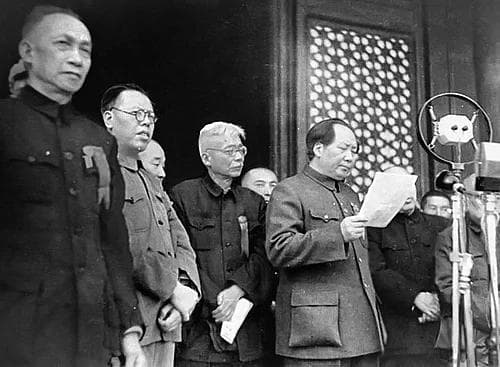
On October 1, 1949, Mao Zedong proclaimed the establishment of the People's Republic of China from Tiananmen Gate, ending the Chinese Civil War and beginning Communist Party rule.
Narrative Comparison
| Source | Narrative |
|---|---|
| PRC Official Narrative | The founding marked the end of a century of humiliation and the beginning of national rejuvenation under Communist Party leadership. |
Key Milestones
- CPPCC First Plenary Session Opens
The Chinese People's Political Consultative Conference convened in Beijing, bringing together representatives of the Communist Party, democratic parties, and mass organisations to finalise preparations for the founding of the new state.
- Common Program Adopted
The CPPCC adopted the Common Program of the Chinese People's Political Consultative Conference, which served as the provisional constitution of the new state, defining the PRC as a "people's democratic dictatorship" led by the working class.
- Central People's Government Committee Established
The CPPCC elected Mao Zedong as Chairman of the Central People's Government, with Zhu De as Commander-in-Chief of the People's Liberation Army. The state apparatus of the new republic was formally constituted.
- Founding Ceremony at Tiananmen
Mao Zedong proclaimed the founding of the People's Republic of China from Tiananmen Gate before a crowd of 300,000. The Five-Star Red Flag was raised for the first time, and a 54-gun salute rang out — one shot for each of the 54 ethnic groups recognised at the time.
- Soviet Union First to Recognise the PRC
The Soviet Union became the first country to formally recognise the People's Republic of China, just one day after its founding. Eastern European socialist states followed within days. Western nations, led by the United States, refused recognition, deepening the Cold War divide.
- Republic of China Government Retreats to Taiwan
Chiang Kai-shek and the remnant Nationalist government completed their evacuation to Taiwan following the fall of Chengdu — the last major mainland city. The cross-strait division that persists to this day was thus established.
Sub-Events
Peaceful Liberation of Beiping
On 31 January 1949, General Fu Zuoyi surrendered Beiping to the People's Liberation Army without armed resistance, preserving the ancient capital's historical fabric and delivering a decisive blow to the Nationalist cause.
Crossing of the Yangtze River
The PLA's crossing of the Yangtze River in April 1949 shattered the Nationalist government's last major defensive line and opened the path to the capture of Nanjing, the Nationalist capital, effectively ending organised Nationalist resistance on the mainland.
CPPCC First Plenary Session
The First Plenary Session of the Chinese People's Political Consultative Conference convened in Beijing from 21–30 September 1949, adopting the Common Program and the Organic Law of the Central People's Government, and electing Mao Zedong as Chairman — the final political act before the formal proclamation of the PRC.
Five-Star Red Flag Adopted as National Flag
On 27 September 1949, the CPPCC adopted the Five-Star Red Flag as the national flag of the People's Republic of China. Designed by economist Zeng Liansong, the flag's large star represents the Communist Party and the four smaller stars represent the four social classes united under its leadership.
March of the Volunteers Adopted as National Anthem
On 27 September 1949, the CPPCC adopted "March of the Volunteers" — composed by Nie Er with lyrics by Tian Han — as the provisional national anthem of the PRC. Originally written for a 1935 anti-Japanese resistance film, the anthem became a symbol of national sacrifice and struggle.
Last verified: